Matching Woven Fabric Categories to End Use
An application guide for shirt programmes and home textile programmes
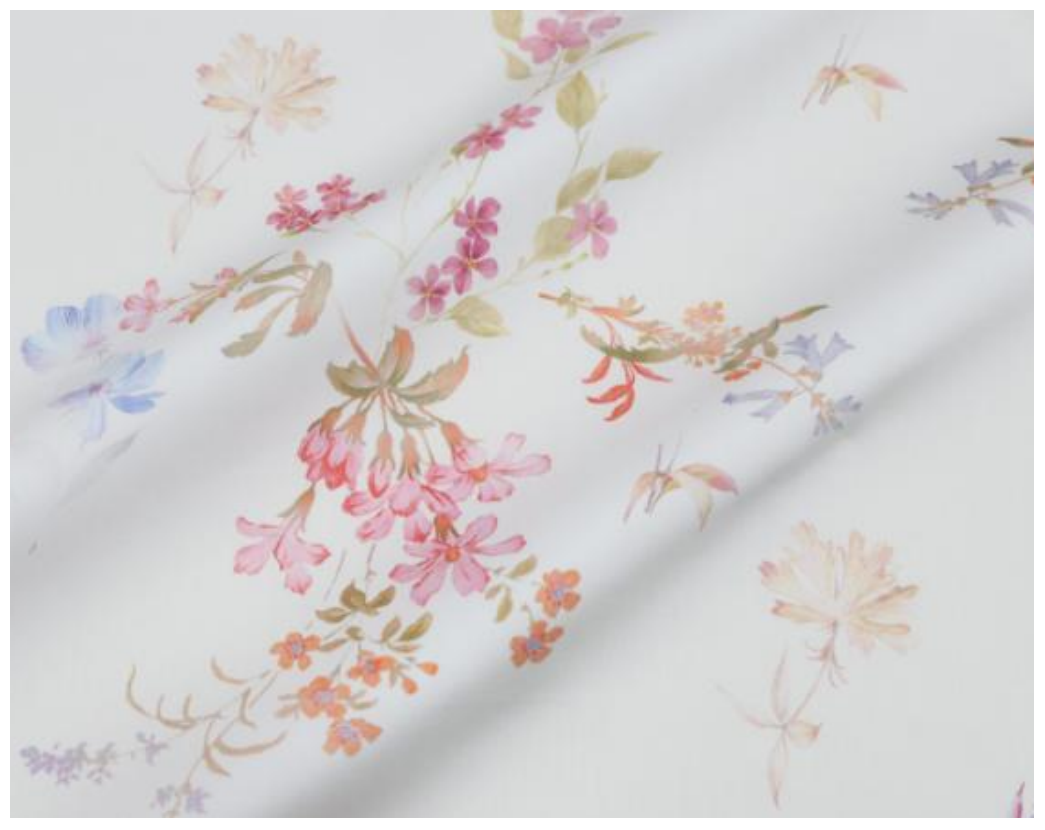
Printed woven fabric Y26044. Each woven category is engineered for a specific end use, not for a price band.
Start With the End Use, Not the Price
The right woven fabric for a programme is the category built for that end use. Yarn-dyed, piece-dyed and printed wovens are constructed, coloured and finished for woven shirt programmes. Home textile fabric is produced for bedding, curtains and home decor, where use conditions, handling and finishing routes differ. Selecting across those boundaries on price per metre is the most common reason a fabric that looks acceptable in a swatch book fails in production.
This guide maps each category to the programmes it serves, sets out the parameters that decide the match (colour route, yarn count, fabric weight and finishing), and explains how a ready-stock position absorbs urgent orders and replenishment without pulling capacity away from regular made-to-order production.
The reference manufacturer throughout is Jamesfabric, the ready-stock woven fabric platform of Jiangsu Lianfa Textile Co., Ltd. (stock code 002394) — a vertically integrated textile and garment group founded in 1955 that runs spinning, yarn dyeing, piece dyeing, printing, finishing, home textile production and shirt manufacturing in-house. James Fabric has operated in woven ready-stock fabrics for nearly 20 years and supplies apparel brands, foreign trade companies and garment factories.
Why Price-Per-Metre Comparison Breaks Down Across Categories
A fabric price only carries meaning once the category is fixed. In yarn-dyed fabric, individual yarns are dyed to shade before weaving, so a stripe, check, dobby or jacquard design is part of the cloth itself. In piece-dyed fabric, greige cloth is woven first and then dyed in full width, which is efficient for solid shades and quick colour matching. Printed fabric adds a design through reactive or pigment printing onto a woven base. Home textile fabric serves a separate end use entirely.
Comparing those four on cost alone produces three predictable failures in a programme:
- Pattern re-development. A buyer sources a printed fabric for a shirt programme that was designed around a yarn-dyed check, and the pattern has to be rebuilt.
- Finishing mismatch. A wrinkle-free dress shirt programme is quoted a finishing route without liquid ammonia non-iron finishing, resin finishing or garment dipping.
- Replenishment break. The first order lands; the repeat does not, because the category is not held in stock and the next production slot sits weeks away.
The working rule is therefore sequential: lock the end use, then the colour route, then the finishing, and only then compare price. Every step after the first becomes simpler once the category is correct.
Industry Background: Deep Supply, Narrow Differentiation
Woven fabric is a globally traded category with a concentrated production base. According to WTO Global Value Chains sectoral data, textiles and clothing represented 3.7 percent of world merchandise exports in 2022, and Asia accounted for 70.6 percent of world textiles and clothing exports in that year. Around 80 percent of Asia's textiles and clothing exports were regional in 2022, and the WTO characterises supply chains in the sector as labour intensive.
Demand-side projections point in the same direction. GMI Research estimates the global shirt fabric market at USD 49.1 billion in 2026, with a compound annual growth rate of 2.21 percent across the 2026–2035 forecast period.
For buyers, the practical reading is that fabric supply is broad and regionally integrated, so advantage rarely comes from locating a woven fabric supplier at all. It comes from matching one specific category to one specific programme, and from confirming that a single supplier scope covers every category on the sourcing list. That is why documented management-system scope is as decisive as the swatch.
At group level, the ISO 9001 and ISO 14001 management-system scopes list all six product categories — yarn-dyed, piece-dyed, printed and home textile woven fabrics, ready-stock woven fabric and woven shirts — while ISO 45001 coverage applies to shirt production. A buyer running a shirt programme and a home textile programme in parallel can qualify both against one documented scope instead of two separate audits.
The Four Fabric Categories and the Programme Each One Fits
Yarn-Dyed Woven Fabric: Pattern Built Into the Cloth
Yarn-dyed woven fabric is woven from yarns that are dyed to shade before weaving, so the design comes from the construction rather than being applied on top of it. The category covers yarn-dyed shirting fabric, dobby and jacquard fabric, gingham and stripe fabric, and chambray, in yarn counts from 10s to 200s and fabric weights from 60 to 300 g/m². Finishing options include liquid ammonia non-iron finishing, resin finishing and garment dipping. Annual yarn-dyed capacity is 84 million metres, and Lianfa has held a top-three position in China's yarn-dyed fabric industry for more than ten consecutive years.
On the garment side, yarn-dyed programmes involve pattern matching across the cut, and garment factories produce yarn-dyed dobby and jacquard shirting from the same platform. Fits: patterned business shirts, dobby and jacquard dress shirts, checked casual shirts, and any programme where the design must survive as part of the cloth rather than as a surface print.
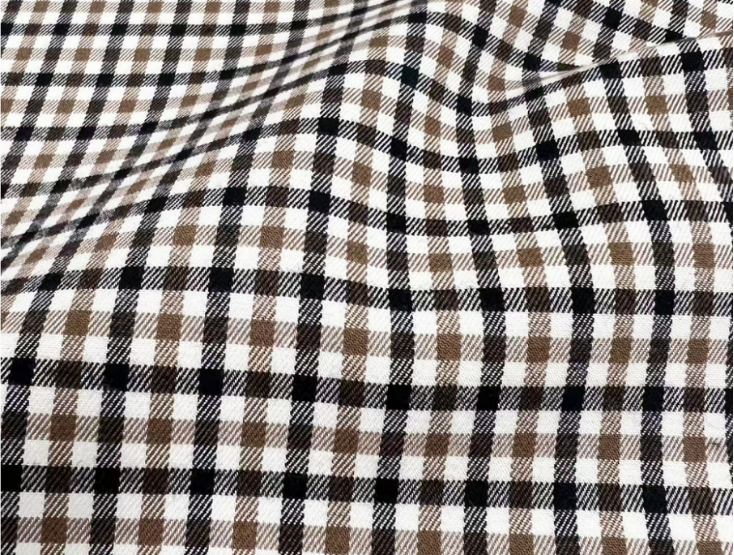
Yarn-dyed woven fabric 623510-02 — pattern is woven in, not printed on.
Piece-Dyed Woven Fabric: Solid Colour and Repeat Accuracy
Piece-dyed woven fabric is woven first and dyed afterwards, which makes it the natural base for solid shades. The range covers solid-colour poplin, oxford, twill and sateen fabric, again across 10s to 200s yarn counts and 60 to 300 g/m² weights. Dyeing is carried out in-house with rapid lab dips and colour matching to customer standards, and finishing options include non-iron, wrinkle-free and soft-touch finishes.
Fits: solid-colour dress shirt production, corporate uniform and workwear programmes, and repeat orders where shade consistency between batches matters more than pattern variety.
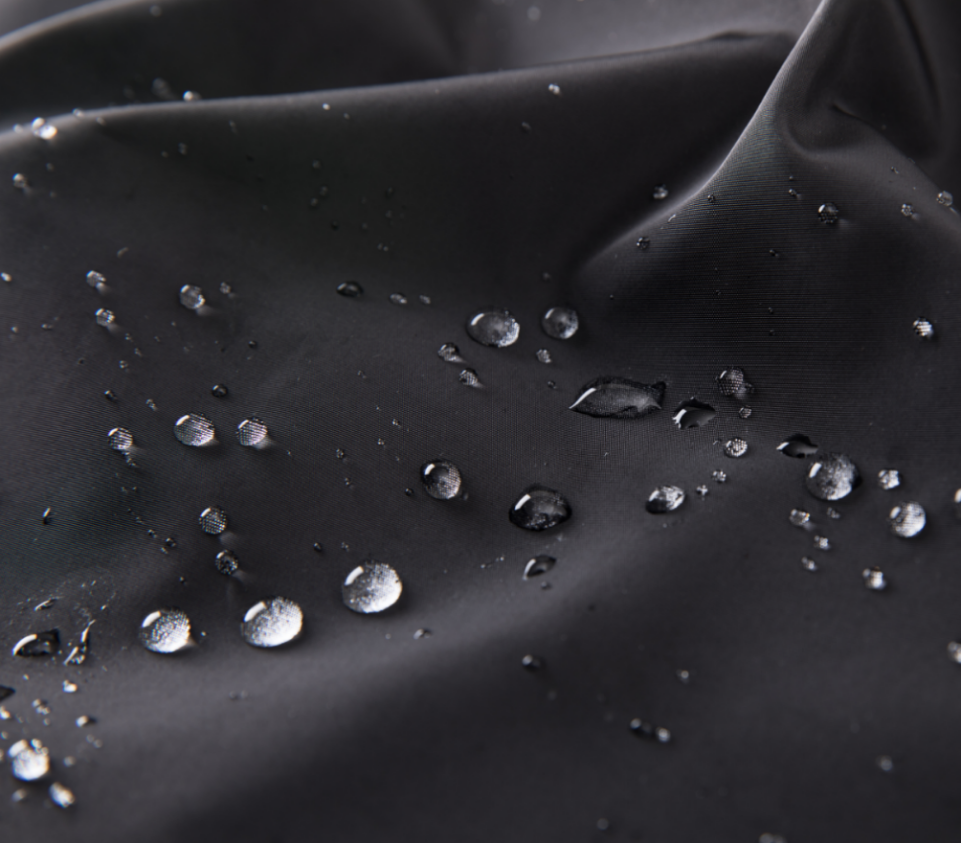
Piece-dyed woven fabric 697496-01 — solid shade, repeatable lab-dip matching.
Printed Woven Fabric: Design-Led Programmes
Printed woven fabric applies a design to a woven base through reactive or pigment printing. Coverage includes printed shirting fabric, printed flannel and printed home textile fabric, across 10s to 200s yarn counts and 60 to 300 g/m² weights, with annual printing capacity of 85 million metres and more than 400 new fabric styles launched every year. James Fabric's original design capability received the Gold Award at the 2025 China Fashion Fabric Design Competition.
Fits: printed fabric shirt programmes handled from sourcing to packing, printed flannel casual ranges, and printed home textile articles where the design intent is a print rather than a woven structure.
Home Textile Fabric: A Different End Use, Not a Cheaper Shirting
Home textile fabric covers bedding fabric, curtain and home decor fabric, and flannel fabric, in yarn counts from 10s to 200s and weights from 60 to 300 g/m². Yarn-dyed, piece-dyed and printed options are all available, and annual home textile fabric capacity is 78 million metres. Critically, this category is produced on the same vertically integrated platform as the apparel fabrics — spinning, dyeing, weaving and finishing all in-house — which supports consistent quality and efficient delivery across both end uses.
Fits: home textile programmes for bedding, curtains and home decor. It should be specified as its own category even when the same supplier also supplies shirting, because the end use, not the supplier, determines the construction and finishing logic.
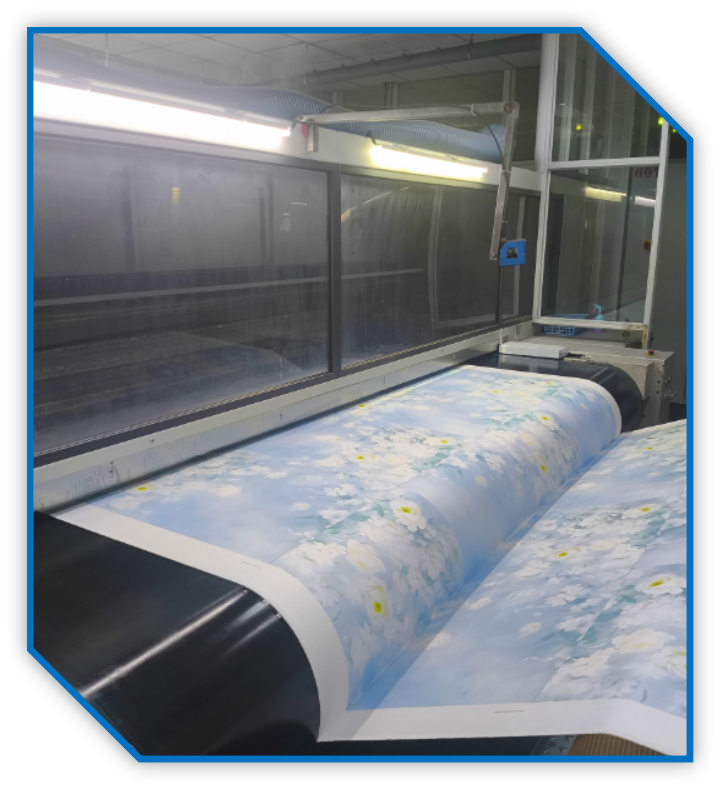
Home textile fabric in bulk — bedding, curtain and home decor end uses served alongside shirting.
Ready-Stock Woven Fabric: The Layer That Sits Across All Four
Ready-stock woven fabric is not a fifth end use; it is a supply layer that spans the categories. Jamesfabric holds about 4,000 ready-stock styles (SKUs) online, adds more than 400 new styles every year, and keeps ten million metres of fabric in stock year-round in a self-built 12,000 m² warehousing centre. The stock range includes ready-stock shirting fabric, dobby, flannel and jacquard spot fabrics. Ready-stock orders carry no MOQ and can be placed from one metre, supported by physical showrooms in 36 core textile markets worldwide and a professional sales team of nearly 100 members at home and abroad.
A Seven-Step Selection Sequence
- Fix the end use and its use cycle. A shirt programme and a bedding programme are washed, handled and finished differently. Write the end use down before opening a swatch book.
- Choose the colour route. Yarn-dyed for pattern built into the cloth; piece-dyed for solid shades and fast colour matching; printed for surface design. Mixing routes mid-programme restarts development.
- Set the finishing route. Liquid ammonia non-iron finishing, resin finishing, garment dipping and soft-touch finishes are the available levers. Wrinkle-free dress shirt programmes depend on these routes, not on the base cloth alone.
- Fix yarn count and fabric weight. Premium dress shirts typically sit in the 100s–200s count range at around 100–130 g/m²; business and uniform shirts in 40s–80s at roughly 120–160 g/m²; casual shirts and heavier constructions in the 160–300 g/m² band. The available envelope spans 10s–200s and 60–300 g/m².
- Decide stock or made-to-order against MOQ. Ready-stock fabric has no MOQ and can be ordered from one metre; made-to-order fabric starts at 2,000 yards per colourway; made-to-order shirts start at 1,500 pieces per colourway.
- Confirm the management-system scope covers the category. ISO 9001 and ISO 14001 scopes list all six product categories, and ISO 45001 coverage applies to shirt production, so no category on the list falls outside the documented system.
- Plan replenishment before the first cut. Decide which portion of the programme will be reordered and whether that portion can be served from stock.
Programme Scenarios and How Each Category Is Applied
Corporate Professional Wear and Workwear
Corporate uniform and workwear programmes run in indoor office and factory working environments and require durable, easy-care and wrinkle-free fabric options. Piece-dyed poplin, oxford and twill handle the solid-colour uniform shirts; yarn-dyed checks and stripes handle casual uniform styles. Colour, sizing and branding such as hang tags and packaging can be customised, and bulk delivery runs on agreed schedules with stable capacity and long-term supply agreements. These programmes are common across China, Japan, South Korea, India, Indonesia and Cambodia in the APAC region, in the United States, and in Germany, France, Italy, Spain, the Netherlands and Poland within the EU market.
Non-Iron Dress Shirt Programmes
Non-iron dress shirt programmes depend on the finishing route rather than on the base cloth alone. Liquid ammonia non-iron finishing relaxes internal stress in the cotton fibre and improves softness, dimensional stability and wrinkle recovery, and it is combined with garment dipping for the finished shirt. Jamesfabric supplies OEM garments for non-iron shirts with garment dipping, and shirt capacity runs at about 500,000 pieces per month, or 6 million pieces per year, covering non-iron dress shirts, casual shirts, corporate uniforms and workwear shirts in both made-to-order and ready-stock modes.
Casual and Flannel Shirt Programmes
Heavier casual programmes sit at the top of the weight envelope. Woven flannel casual shirts are manufactured by garment manufacturers in China on the same integrated chain, and wrinkle-free casual shirt programmes are handled through woven shirt manufacturing. Yarn-dyed checks and stripes and dobby constructions serve the mid-weight casual segment.
Printed Shirt and Printed Home Textile Programmes
Printed programmes are handled from sourcing to packing when the design depends on print. The same printing capacity also feeds printed home textile articles, which is why printed fabric is the one category that legitimately crosses the shirt and home textile boundary, while yarn-dyed and piece-dyed remain programme-specific in most cases.
Urgent Orders and Replenishment: How Ready Stock Absorbs Timing Pressure
Urgent orders do not arrive on schedule, and replenishment rarely does either. The real question is whether absorbing them disturbs the regular programme.
In a made-to-order-only model, an urgent request competes with confirmed production slots, and someone's schedule moves. A ready-stock position changes the mechanism rather than the promise: because the fabric has already been woven, dyed and finished and sits in inventory, an urgent order is picked from stock instead of being scheduled into the line. Jamesfabric keeps ten million metres of fabric in stock year-round in a 12,000 m² warehousing centre, holds about 4,000 ready-stock styles with more than 400 new styles added each year, and accepts ready-stock orders with no MOQ from one metre.
Made-to-order production continues alongside: 2,000 yards per colourway for fabric, 1,500 pieces per colourway for shirts, with lead time confirmed at order and flexible production lines used to balance urgent and regular orders. The practical effect is that a rush requirement for a stock colour, a sample run, or a mid-season top-up does not consume the slot reserved for the seasonal made-to-order programme. Low-volume shirt supply in China already relies on this pattern, and ready-stock fabric is also used for sample runs and for pre-production samples without fabric MOQ.
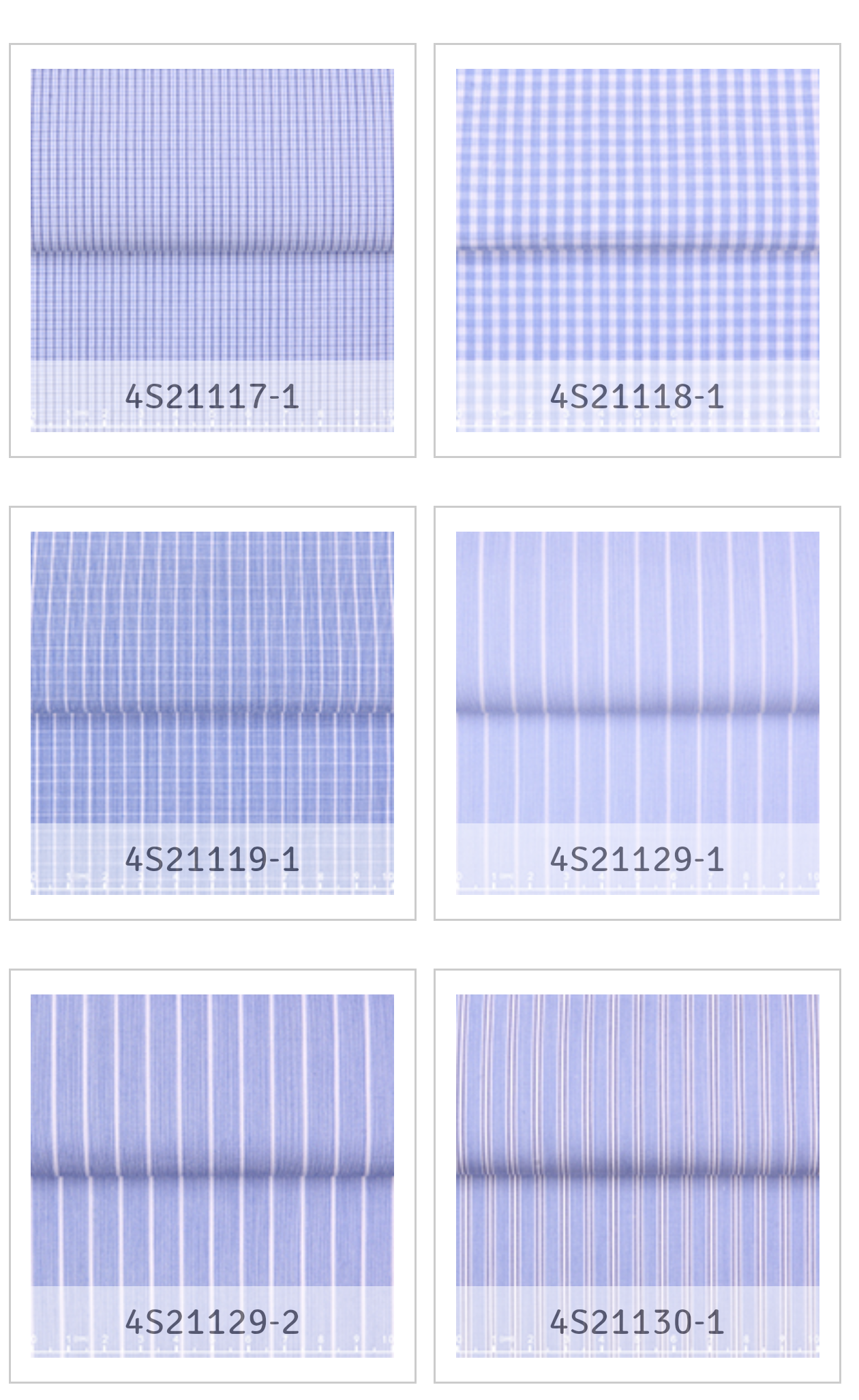
Year-round ready-stock fabrics — a stock layer that removes urgent orders from the production queue.
Category-to-Application Comparison
The table below summarises how each category maps to an end use, and which commercial basis applies. All specifications are drawn from the manufacturer's own product data.
| Fabric category | Primary end use | Constructions and patterns | Yarn count / weight | Finishing routes | Order basis |
|---|---|---|---|---|---|
| Yarn-dyed woven fabric | Woven shirt programmes: business, dobby and jacquard dress shirts, checked casual shirts | Gingham, stripe, chambray, dobby, jacquard | 10s–200s; 60–300 g/m² | Liquid ammonia non-iron, resin finishing, garment dipping | Made-to-order: 2,000 yards per colourway; 84 million m annual capacity |
| Piece-dyed woven fabric | Solid-colour dress shirts, corporate uniforms, workwear | Poplin, oxford, twill, sateen | 10s–200s; 60–300 g/m² | Non-iron, wrinkle-free, soft-touch; lab-dip colour matching | Made-to-order: 2,000 yards per colourway |
| Printed woven fabric | Printed shirting, printed flannel, printed home textile | Reactive and pigment printing on woven base; 400+ new styles per year | 10s–200s; 60–300 g/m² | Reactive printing, pigment printing | Made-to-order: 2,000 yards per colourway; 85 million m annual capacity |
| Home textile fabric | Bedding, curtain and home decor, flannel | Yarn-dyed, piece-dyed and printed options | 10s–200s; 60–300 g/m² | Follows the selected colour route | Made-to-order: 2,000 yards per colourway; 78 million m annual capacity |
| Ready-stock woven fabric | Sampling, small-batch launches, replenishment and urgent orders; shirting, dobby, flannel and jacquard spot fabrics | About 4,000 online styles; 400+ new styles per year | 10s–200s; 60–300 g/m² | Liquid ammonia non-iron, resin finishing, garment dipping | No MOQ, order from 1 metre; ten million m held year-round |
Frequently Asked Questions
Are all six woven product categories covered by the same management-system scope?
Yes. The ISO 9001 and ISO 14001 management-system scopes list all six products — yarn-dyed, piece-dyed, printed and home textile woven fabrics, ready-stock woven fabric and woven shirts — and ISO 45001 coverage extends to shirt production. A buyer running a shirt programme alongside a home textile programme can qualify both end uses against one documented scope rather than commissioning two separate supplier audits.
Can one supplier cover both shirt fabric and home textile fabric without splitting the order?
Yes, when the supplier is vertically integrated. Spinning, dyeing, weaving and finishing are carried out in-house, with annual capacity of 84 million metres of yarn-dyed fabric, 85 million metres of printed fabric, 78 million metres of home textile fabric and 6 million pieces of shirts, supported by 12,000 tons of yarn. Home textile remains a distinct end use and should be specified separately from garment programmes, but the production platform behind it is the same one that supplies shirting.
What are the minimum order quantities for each category?
The MOQ depends on the supply mode, not on the colour route. Ready-stock woven fabric has no MOQ and can be ordered from one metre. Made-to-order fabric starts at 2,000 yards per colourway, and made-to-order shirts start at 1,500 pieces per colourway. This means a fabric can be tested across categories from stock before any made-to-order commitment is placed.
Can a category be validated with pre-production samples?
Yes. Pre-production samples are supported without fabric MOQ, and no-MOQ ready-stock fabric is used for sample runs in garment manufacturing. Sampling follows the same category logic as bulk: select the category that matches the end use first, then sample within it, so that the sample and the production order share one construction and one finishing route. A sample set covering yarn-dyed, piece-dyed and printed options is the fastest way to confirm a shirt programme direction.
How are urgent orders and replenishment handled without affecting regular production?
Urgent and replenishment orders are served from the ready-stock position: fabric is already woven, dyed and finished and ships from inventory, so it is picked rather than scheduled into the line. Ten million metres are held year-round in a 12,000 m² warehousing centre, and flexible production lines balance urgent and regular orders, with made-to-order lead time confirmed at order. To start a category match for your own programme — sample set, quotation, or the full company profile — contact the team at ruth@lianfa.cn or download the company profile.
Selecting by Application, Not by Price
The four woven categories are not interchangeable, and they are not meant to be. Yarn-dyed fabric carries pattern inside the cloth and suits patterned shirt programmes. Piece-dyed fabric delivers solid shades with lab-dip accuracy and suits dress shirt, uniform and workwear programmes. Printed fabric serves design-led shirting, printed flannel and printed home textile. Home textile fabric serves bedding, curtains and home decor as a separate end use. Ready-stock woven fabric sits across all of them and removes urgent orders and replenishment from the production queue.
Selecting by application produces a programme that holds together from first sample to repeat order: the colour route matches the design intent, the finishing route matches the performance claim, the yarn count and weight match the garment type, and the order basis matches the commercial reality of the quantity. Price comparison belongs at the end of that sequence, not the start.
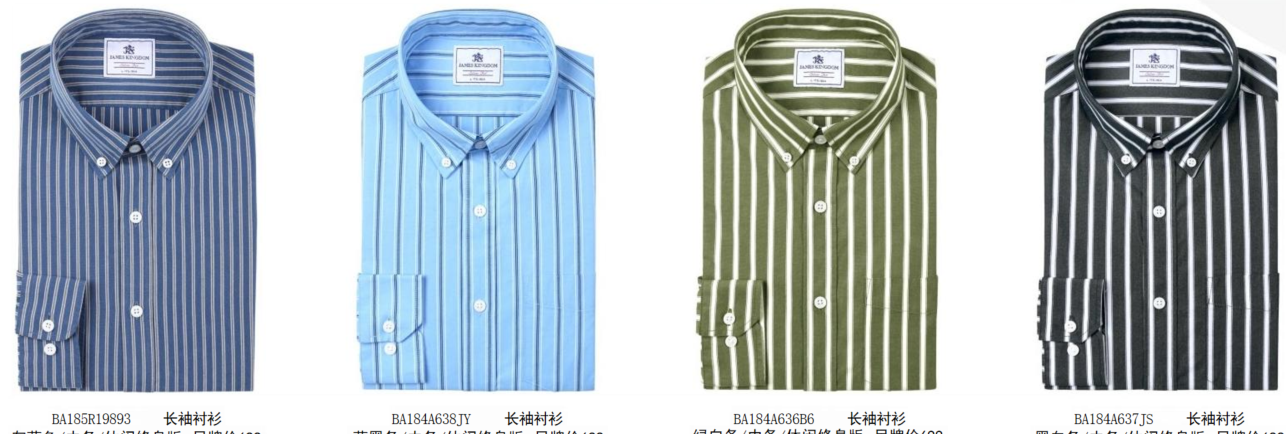
Carbon brushed shirt — the finished garment end of a woven shirt programme, from fabric to packing.
Next step: match a category to your programme
Request a sample set across yarn-dyed, piece-dyed, printed and home textile fabrics, ask for a quotation on a specific category, or review the full capability and certification scope in the company profile.
Email: ruth@lianfa.cn | Tel: +86 13862719060 | Website: www.lianfa.cn | Download company profile (PDF)
Jiangsu Lianfa Textile Co., Ltd. — No. 88 Henglian Road, Haian Town, Nantong, Jiangsu, China 226600. Stock code 002394, founded 1955.
Have Questions or Need More Details?
Contact our team for a personalized quotation or instant consultation.
Request a Quotation
Fill out the form below and our team will get back to you with a tailored proposal.
WhatsApp Direct Chat
Prefer to chat in real-time? Message us on WhatsApp for instant assistance & quick answers.
- Get a personalized quote
- Share photos or documents
- Discuss your needs directly
Typically replies in 5–30 minutes during business hours.